Earthquakes and foundations in Summerville
The largest earthquake in the recorded history of the East Coast was centered a few miles down the Ashley from Main Street, and the fault zone has produced 34 quakes since 2021. The Town's answer is Seismic Design Category D2. Here's what that means when we dig a footing.
August 31, 1886
At 9:51 p.m. the ground near Middleton Place — the plantation on the Ashley a few miles southeast of Summerville — ruptured in what the USGS catalog lists as a magnitude 7.03 earthquake (the state's older estimate was 7.6). About 60 people died, mostly in Charleston; the shaking was felt over two and a half million square miles, from Cuba to Boston; Summerville's own houses were wrecked. The University of South Carolina's seismic network puts the epicenter 'likely near Middleton Place,' and the sand blows the quake left in the ground show that the same zone produced large earthquakes roughly 500, 1,000 and 1,600 years before that.
It hasn't stopped
The Middleton Place–Summerville Seismic Zone is the most active in the state. The state's natural resources department says about 70 percent of South Carolina's earthquakes occur in the Coastal Plain, clustered at Middleton Place–Summerville, Ravenel–Adams Run–Hollywood and Bowman. The zone produced a magnitude 4.8 in 1912, a 4.4 in 1959, a 4.7 in 1974 and a 4.1 in 1992. Since 2021 the USGS has logged 34 earthquakes within 35 kilometers of Summerville: a 3.3 near Ladson on September 27, 2021 with 2,806 felt reports; a 2.2 a kilometer northeast of Summerville on July 16, 2025; and a cluster in February 2026 — 2.2 on the 3rd, 2.9 on the 8th, 2.5 on the 12th — with 902 felt reports. (The Elgin–Lugoff swarm near Columbia that began in December 2021 is a different fault system; don't confuse the two.)
What the code requires
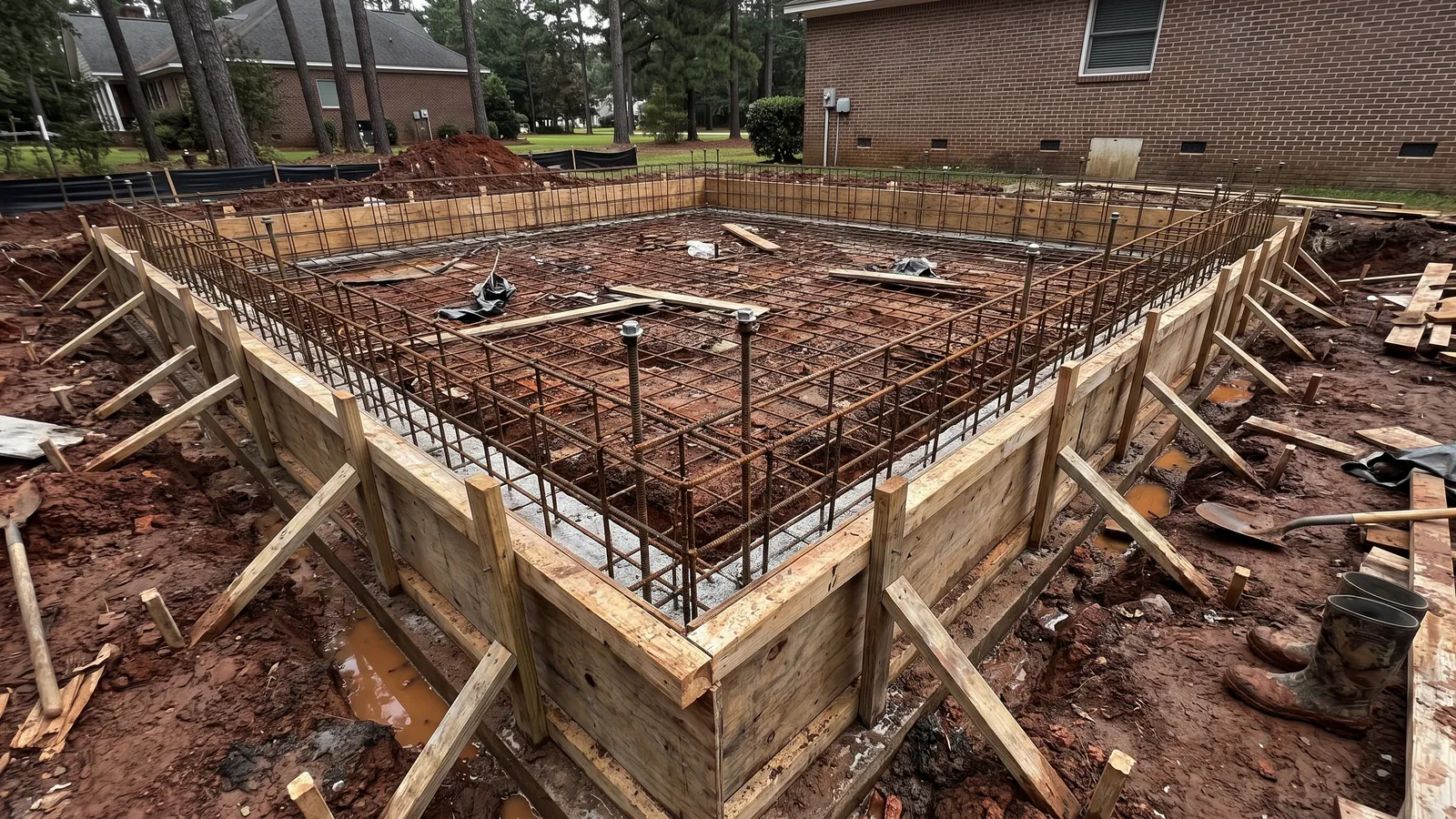
The Town of Summerville's building permit guidelines set the Seismic Design Category at D2 under the residential code (IRC) and D under the building code (IBC) — the categories reserved for places where a damaging earthquake is a real possibility. For a house foundation that changes almost everything about the footing. Under the lower categories common across most of the country, a slab with a turned-down edge or a plain footing with a few bolts is fine. Under D2: continuous footings reinforced top and bottom; stem walls tied to the footing with dowels; anchor bolts at close spacing with plate washers; hold-down anchors where the engineer's lateral analysis calls for them; reinforcement in masonry stem walls; and a stamped foundation plan from a structural engineer that the Town's inspector checks against before the pour. The Town schedules inspections next-day if requested by 3 p.m., and its building FAQ says the inspectors will try to accommodate time frames for concrete pours only — which we use.
What the ground adds
A footing here also has to deal with everything in the soils guide: the water table a foot down in winter (trenches fill; we dewater and pour on compacted stone, never into mud), the Mouzon-Brookman-Wahee clays' shrink-swell (footings carried below the active zone), and the flood maps (both counties require residential finished floors two feet above base flood elevation, which sets the foundation height for an addition regardless of the existing house). The 1886 quake's sand blows are a reminder that saturated sandy ground can liquefy in strong shaking — another reason the engineer's plan matters more here than the builder's habit.
What it costs
A reinforced D2 footing and stem wall runs $45 to $85 per linear foot in 2026 — excavation, forms, rebar, pour and inspection — and a monolithic slab with an engineered turned-down footing $9 to $14 a square foot. A crawlspace foundation for a typical addition is $8,000 to $20,000 depending on size and height; a slab-on-grade addition foundation $10 to $16 a square foot. The engineer's plan is separate. It's more steel and more bolts than a slab in Ohio, and it's the one part of the house you can't fix later.
Insurance
Standard homeowners policies exclude earthquake damage. An earthquake endorsement is available from most carriers in South Carolina and is cheap relative to the Lowcountry's wind and flood coverage; on the Middleton Place–Summerville zone it's worth the conversation with your agent. We're not insurance advisers — ask them.
Common questions
Do I really need an engineer for a small addition?
In Seismic Design Category D2, the Town wants a stamped foundation plan for structural work, and the engineer sizes the footing for your soil and the lateral loads. It's a modest fee against the cost of a foundation that doesn't meet code.
Does my existing 1990s house meet D2?
Possibly not — the categories and the code have tightened. It doesn't have to be retrofitted, but an addition to it does have to be built to the current category, and the connection to the old foundation is part of the engineer's plan.
Can a slab foundation be D2?
Yes — a monolithic slab with an engineered turned-down footing, reinforced and bolted per the plan. Garages and workshops are usually built that way.
Is the earthquake risk real, or just a code formality?
Real. The 1886 quake is the largest ever recorded on the East Coast, the zone has produced magnitude 4-plus events four times since, and 34 small quakes since 2021. Most are harmless; the code is written for the one that isn't.
Related: Foundations & additions · Why concrete cracks here · Flood zones guide · Shed & generator pads